

Article Detail
11 Aug
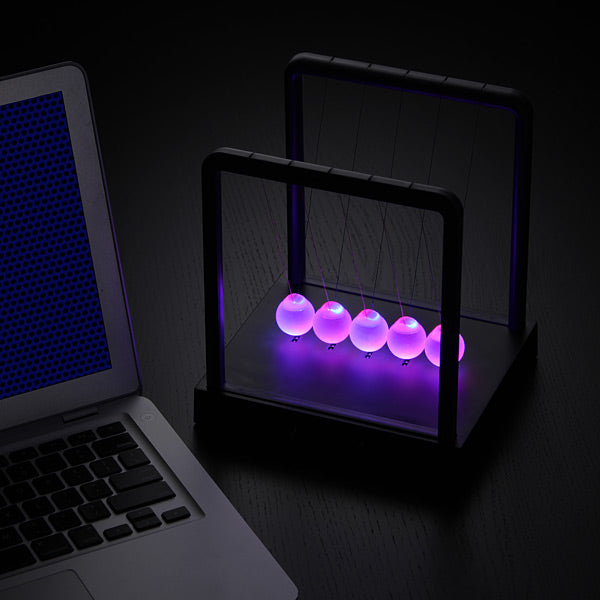
A Physics' class or lecture might not be fun to you in anyway but the pleasure you will derive from fiddling with a Newton's cradle could be one that keeps you asking for more. The Newton's cradle typically consists of a set of five small metal balls that are suspended [at varying angles] across a frame by strings. It has been so named after Newton because the idea behind it, is based on the conservation of momentum and energy- which is one of the foremost works of Isaac Newton.
So, how does the Newton's cradle work? You might have wondered [while playing with a Newton's cradle] why the ball at the the other extreme have to move [with the center three (balls) showing a negligible movement] upon swinging the ball from the end you chose. Well, what normally happen in such scenario [as of the Newton's cradle] is that the ball you pulled away [and released for a swing] transfers its momentum to the ball at the other extreme through the ones at the center- at this point, you need to understand that every entity that is in motion has a force (momentum) with which it moves, and it is the same amount of momentum [garnered by the first ball that was swung] that would be retained throughout the pendulum motion. Hence, it can be said that each of the center three center balls serve as a medium of transfer.
Not to bore you with more explanations- which I have tried to keep as basic as I can; watching the balls of the Newton's cradle swing to and fro, could be the (distractive) tonic you need to relief yourself of anxiety.